
Two numbers decide how far a 6 GHz cell reaches, and the transmit power on the access point’s spec sheet is neither of them. The first is the channel width, because in 6 GHz the width sets the power ceiling. The second is the client’s own ceiling, which sits below the access point’s and carries the harder half of the link. Settle the width, then size the cell to the client. Design in that order and the rest of 6 GHz power stops surprising you.
Everything below is the US and the FCC.
The ceiling is per megahertz, not per channel
Going narrow in 6 GHz to get “cleaner” channels quietly throws away coverage. Drop from a wide channel to 20 MHz for less contention and your clients land weaker and roam later. That is a coverage decision, and most people make it without knowing they made it.
Here is why. In 6 GHz, EIRP is not a flat per-channel ceiling like the one you learned in the old bands. It is governed by power spectral density, a limit measured per MHz. Total radiated power scales with how many MHz you light up.
A narrow channel is legally quieter than a wide one at the same PSD ceiling. The gap between 20 MHz and 160 MHz:
10 · log₁₀(160/20) = 10 · log₁₀(8) ≈ 9 dB
That 9 dB is 8× less power radiated, the same 8× you saved in channel width, spent straight out of your link budget. Every doubling of width is worth 10 · log₁₀(2) ≈ 3 dB, and every halving costs you the same 3 dB.
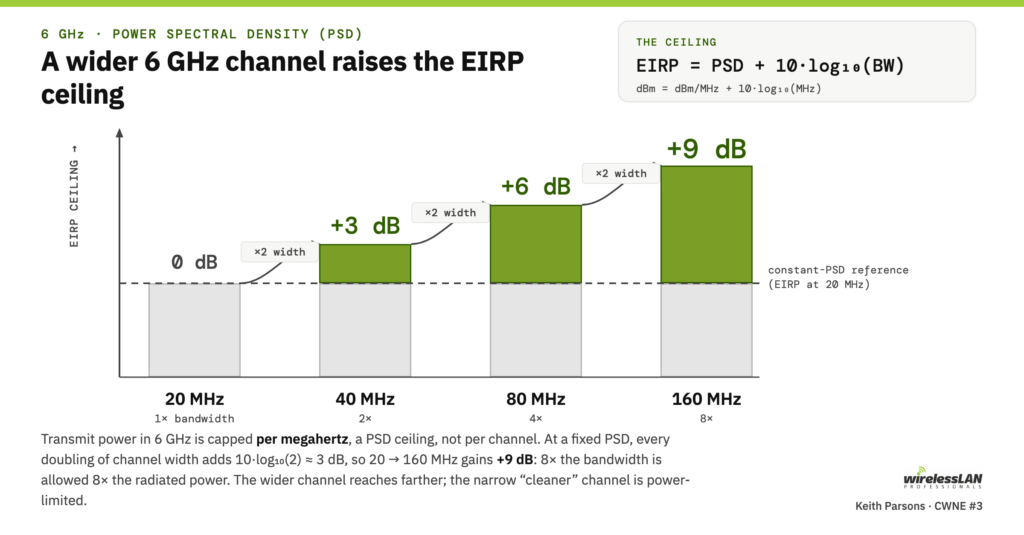
Every doubling of channel width adds 3 dB to the ceiling, so a 20 MHz channel starts 9 dB down on a 160 MHz one before a single wall gets in the way. The gray part of each bar is the power you are allowed at any width. The green part is what the extra width buys you.
The same rule governs the access point, which is where the spec sheet starts misleading you. A Low Power Indoor access point on a 20 MHz channel cannot legally radiate 30 dBm. Its 5 dBm/MHz ceiling caps it at 18 dBm, a full 12 dB under the headline figure, and it reaches the 30 dBm cap only at 320 MHz. The “30 dBm access point” is a 320 MHz access point.
In 6 GHz, channel width is a coverage decision, not only a capacity one. Narrow when the airtime math demands it, but KNOW what the PSD ceiling charges you for it.
One more entry on the same ledger, and this one catches people who are trying to help: antenna gain counts against the EIRP cap. Bolt on a higher-gain antenna and the extra dB of gain comes out of your maximum EIRP, so the access point lowers its own transmit power to compensate. You buy reach and get a quieter radio.
The client transmits 6 dB below the access point
In 6 GHz, the client transmits up to 6 dB below the access point it is associated with. That is not a vendor default you can tune away. In the US it is written into 47 CFR §15.407, and it sets the real limit on the size of your cell.
Same 6 dB, two different mechanisms
Here is the part that trips people up. Low Power Indoor and Standard Power reach that 6 dB by completely different routes.
Standard Power is a live rule. The FCC requires the client to stay at least 6 dB below its access point’s AFC-authorized power. The Standard Power access point’s own ceiling is two numbers, 36 dBm EIRP and 23 dBm/MHz PSD. AFC can grant an access point less than the full 36 dBm at a given location, and when it does, the client tracks 6 dB below whatever the access point was actually cleared to use, and not 6 dB below the ceiling.
Low Power Indoor has no such clause. Its client cap is a flat −1 dBm/MHz and 24 dBm EIRP, sitting 6 dB under the access point’s flat 30 dBm. The gap is the same size, and there is no follow-the-access-point linkage behind it. Same number, different machinery.
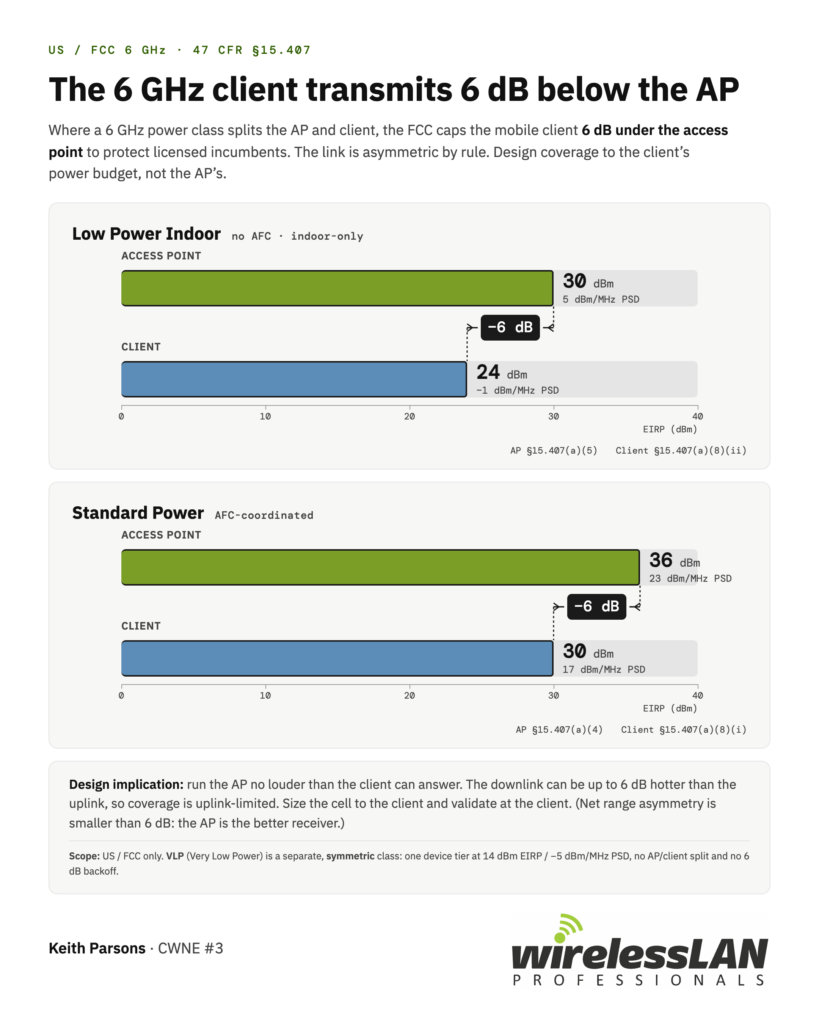
Two panels, the same 6 dB, two different rules producing it. The bar that sizes your cell is the lower one in each panel.
Why the client and not the access point
6 GHz is shared spectrum. Licensed incumbents were there first, and unlicensed Wi-Fi has to stay quiet enough not to bother them.
The access point is the controlled element: fixed location, indoors for Low Power Indoor, AFC-coordinated for Standard Power. The client is the wildcard. It is mobile, there are a lot of them, and any one of them can end up parked at a window with a clean shot at a rooftop microwave dish or a satellite uplink. Capping the client bounds the worst case across the whole population of them at once.
What that does to your cell
Run a Low Power Indoor access point at its ceiling and your downlink is up to 6 dB hotter than anything the client can send back. The client hears the access point long before the access point can hear the client. Coverage is uplink-limited, so size the cell to the client’s power budget, 24 dBm EIRP for Low Power Indoor, and not to the access point’s.
The 6 dB is a transmit-power gap, and it is not a full 6 dB of lost range. The access point is the better receiver, with more antennas and a lower noise figure than any phone, so some of that transmit deficit gets clawed back on the receive side. The link will always be asymmetric. It is usually less asymmetric than the raw 6 dB suggests.
Remember, in Low Power Indoor the client is NOT tied to the access point’s Tx power. It is held against a fixed maximum of 24 dBm EIRP. Turn an access point down to balance the link and you have not raised the client by a single decibel. You have only made your own downlink quieter.
The client inherits the access point’s class
Your 6 GHz client never picks its own power. It inherits whatever access point it joins. Under 47 CFR §15.407(d)(5)(i), a 6 GHz client operates under the control of the access point it associates with. Every question about client power is an access point question.
Join a Low Power Indoor access point and the client is capped at 24 dBm EIRP with a −1 dBm/MHz PSD ceiling. Join a Standard Power access point and that ceiling rises to 30 dBm EIRP and 17 dBm/MHz, and the cell can go outdoors.
The headline is “+6 dB.” That number is honest only on the widest channel.
Why “+6 dB” undersells it
The EIRP ceilings are 6 dB apart: 24 against 30. The PSD ceilings are 18 dB apart: −1 against 17. That second gap is the whole story.
Work each width through the same rule that governs both clients, the lower of the EIRP cap and the PSD ceiling plus the width term, and the two classes separate:
| Channel width | Low Power Indoor client | Standard Power client | Gap |
| 20 MHz | 12 dBm | 30 dBm | 18 dB |
| 40 MHz | 15 dBm | 30 dBm | 15 dB |
| 80 MHz | 18 dBm | 30 dBm | 12 dB |
| 160 MHz | 21 dBm | 30 dBm | 9 dB |
| 320 MHz | 24 dBm | 30 dBm | 6 dB |
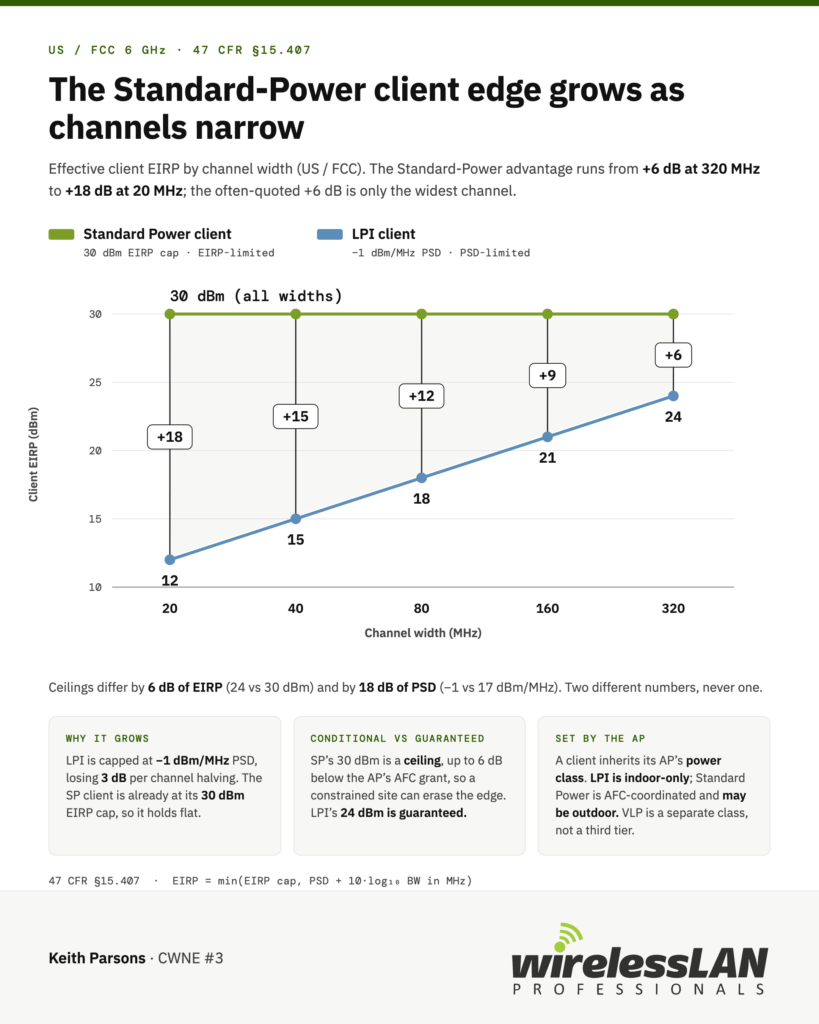
The Standard Power line is flat and the Low Power Indoor line climbs. That divergence is the product being sold: 6 dB at 320 MHz, 18 dB at 20 MHz, and the biggest numbers land on the narrow channels where most clients sit.
“+6 dB” is the minimum, and it shows up only at 320 MHz. Standard Power’s biggest gift to the client lands exactly where Low Power Indoor is most PSD-starved, on the 20, 40 and 80 MHz channels most 6 GHz clients use. Narrow the channel and Low Power Indoor bleeds power fast, while the Standard Power client holds its full 30 dBm.
Standard Power’s 30 dBm is only a ceiling
If AFC authorizes the access point to only 30 dBm at that location, the client sits at 24 dBm, dead even with a Low Power Indoor client. Authorize the access point lower and the Standard Power client drops below a Low Power Indoor client. The gain is real, and it is conditional on what AFC actually grants at that address.
The client also has to support Standard Power at all. Many first-generation Wi-Fi 6E clients shipped Low Power Indoor only. Deploying Standard Power access points does not hand every associated client the 30 dBm ceiling. The client needs the capability too.
A fourth class, running the same client rule
In January 2026 the FCC authorized a fourth class of unlicensed 6 GHz device, Geofenced Variable Power, and the client rule inside it says the client’s ceiling sits 6 dB below the access point’s authorized power, not the power the access point happens to be sending right now.
That is the same design law I keep coming back to: plan to the client, and plan to what the access point is permitted to do, never to what it is doing this second.
GVP is rules on paper. The order took effect April 27, 2026, and no geofencing system has been approved, and no GVP access point or client has been certified or shipped.
The numbers
GVP is authorized in U-NII-5 (5.925 to 6.425 GHz) and U-NII-7 (6.525 to 6.875 GHz), the same two sub-bands as Standard Power.
The GVP access point may transmit up to 24 dBm EIRP and 11 dBm/MHz PSD. The GVP client may transmit up to 18 dBm EIRP and 5 dBm/MHz PSD, with its ceiling pinned 6 dB below its access point’s authorized power.
The one line to memorize
Here is where the FCC pre-empted the mistake nearly everyone makes. The client’s ceiling is 6 dB below the access point’s maximum permitted power, not 6 dB below what the access point is transmitting. The order says it plainly: when a GVP access point runs below its maximum, the client’s limit is still figured from the maximum permitted level, and not from the reduced transmit level.
When geofencing caps the access point below its maximum inside an exclusion zone, the permitted ceiling itself drops, and the client tracks 6 dB below that reduced permitted level. Cap the access point at 14 dBm and the client is held to 8 dBm.
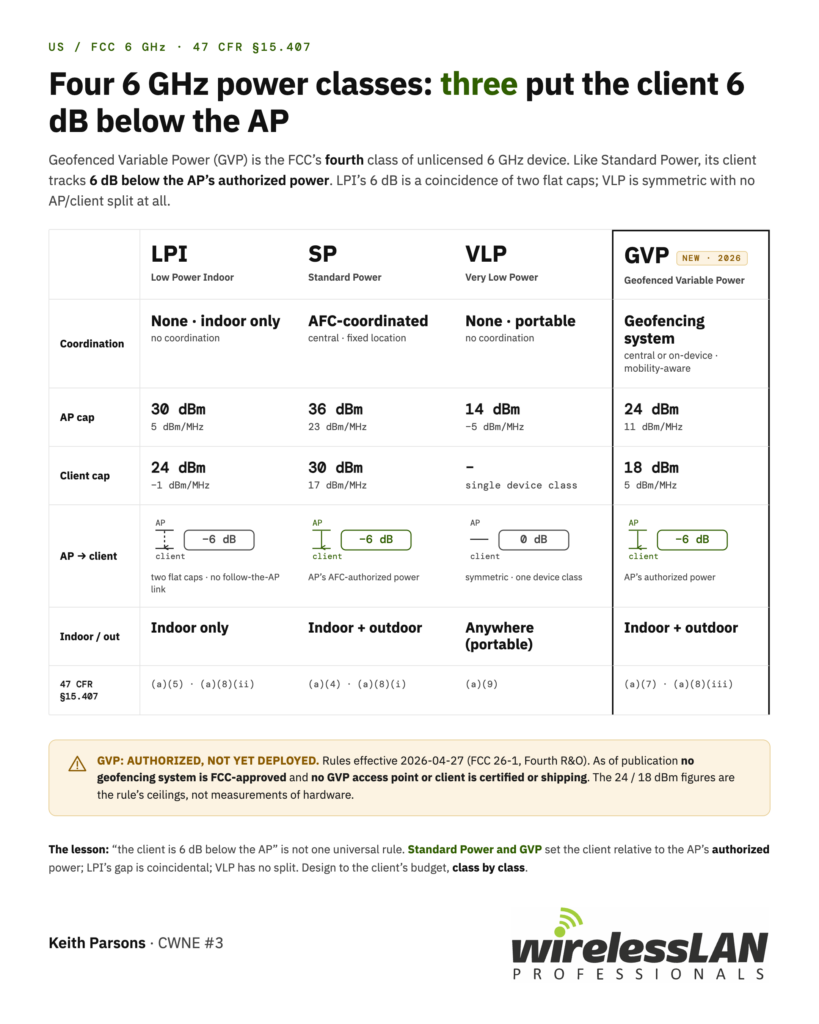
Read the access-point-to-client row straight across. Standard Power and GVP tie the client to the access point’s authorized power, Low Power Indoor’s 6 dB is two fixed caps that happen to land 6 dB apart, and VLP has no split at all. The GVP column is a rule, not hardware you can order.
What “geofenced” actually means
This is what makes GVP a fourth class rather than a flavor of the other three. A GVP access point has to know where it is and be told what it may do there.
It carries built-in geolocation to find its own coordinates. Before it transmits, it registers with and is authorized by a geofencing system. It refreshes that frequency information at least once per day.
AFC assumes a fixed, registered address. Geofencing is built for a device that moves, and the logic may even run on the device itself, which AFC never allows. Read GVP as AFC without the fixed address, the first 6 GHz power class designed for Wi-Fi that moves, outdoors, at real power.
Every Very Low Power device is held to 14 dBm EIRP and −5 dBm/MHz PSD, the lowest ceilings of the four classes. That PSD is NEGATIVE, where the GVP client above sits at a positive 5 dBm/MHz. Once approved systems and certified hardware arrive, GVP will fill the gap VLP cannot reach: higher power than VLP, outdoors, without a fixed AFC registration.
Standard Power buys its power by spending channels
Standard Power buys power by spending channels. At 20 MHz in the US it reaches 41 of the 59 channels Low Power Indoor can use, with 18 dB more power. At 160 MHz it reaches 4 of 7, with 9 dB. Widen the channel and both halves of that trade move against you at once.
The trade, in numbers
Standard Power is authorized in 5.925 to 6.425 GHz and 6.525 to 6.875 GHz. Low Power Indoor is authorized across 5.925 to 7.125 GHz, the entire band. What Standard Power loses is the middle and the top. U-NII-6 sits between the two ranges it keeps, and U-NII-8 sits above them. No Standard Power channel may span the 100 MHz hole at 6.425 to 6.525 GHz, so every channel has to fit whole inside one range or the other. That fit is imperfect even at 20 MHz, and it gets worse as channels widen.
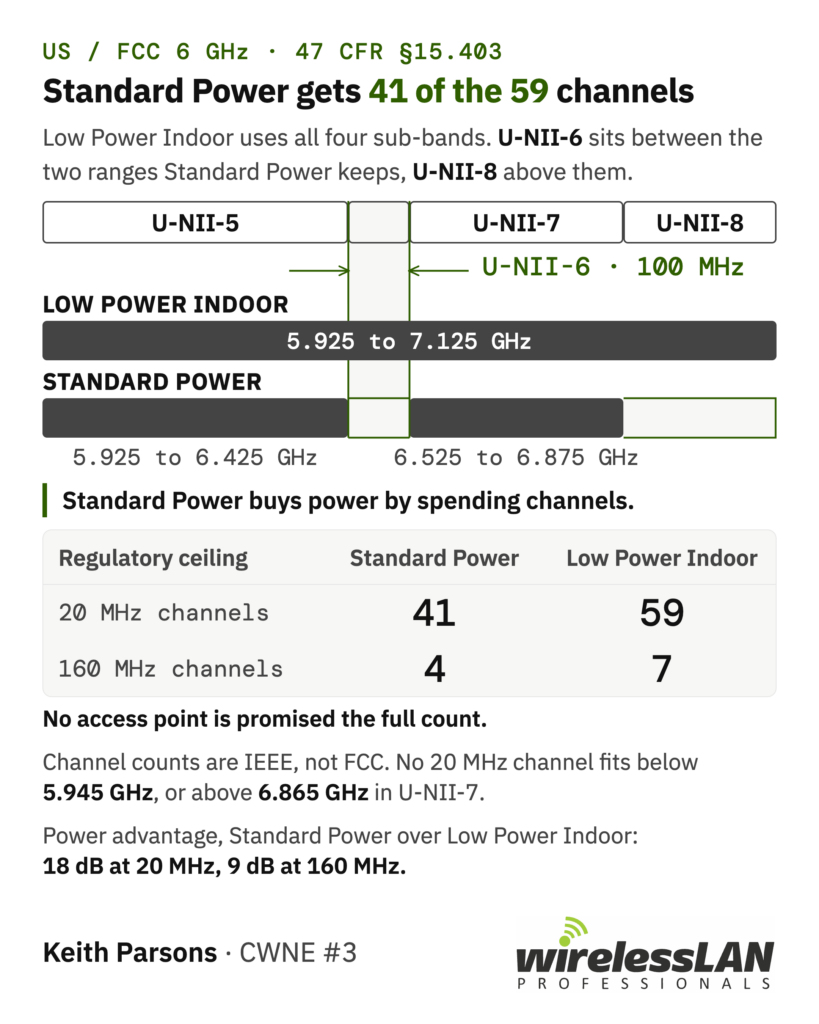
The white gap in the Standard Power row is the argument. U-NII-6 sits between the two ranges Standard Power keeps, so no Standard Power channel may straddle it. The counts in the table are what the rules permit at each width, not what a particular site will be granted.
Put the two halves together and the decision takes a shape. Narrow channels are where Standard Power’s power advantage is largest and where it keeps the largest share of the grid. Wide channels are where it is weakest on both counts.
Where the restriction comes from
The labels U-NII-5 through U-NII-8 appear nowhere in Part 15. They are FCC order and industry shorthand. Part 15 grants rather than prohibits, so the accurate phrasing is that the Standard Power authorization does not extend to U-NII-6 and U-NII-8.
The FCC described those two sub-bands as the ones where “many of the incumbent operations are mobile.” AFC cannot protect what it cannot look up. A transmitter that moves has no location on file, so there is no exclusion zone to compute around it. Standard Power exists only where AFC can work.
And channel counts are IEEE, not FCC. The rules define frequency ranges and power limits, never channels. Lay the 6 GHz channel grid over the authorized ranges and two edges come up short.
One product behavior to ask about
At least one vendor ties an access point configured for Standard Power with Low Power Indoor fallback to the Standard Power channel list in both modes, so it gives up U-NII-6 and U-NII-8 even while running as Low Power Indoor. That is sound engineering, since the access point never has to change channel when the grant lapses. It is also a product decision rather than a rule, so ask your vendor which way theirs behaves.
Before your next 6 GHz design
Four checks, and you can run all of them against a design you already have:
- Pick the channel width before you pick the power, and price the width in dB before you price it in airtime.
- Size the cell at the client’s ceiling: 24 dBm for a Low Power Indoor client, and 6 dB under whatever AFC actually granted for a Standard Power one.
- Count antenna gain against the EIRP cap rather than on top of it, and expect the access point’s transmit power to drop when you add gain.
- Ask your vendor whether an access point in Low Power Indoor fallback still honors the Standard Power channel list.
All four cost you a conversation and a spreadsheet column, and all four are cheaper than a validation survey that comes back short on uplink.
Settle the width first
Indoors, Standard Power is a narrow-channel reach tool and Low Power Indoor is a wide-channel capacity tool. Settle the width first and the power class then follows. That ordering holds for the geofenced class as well, since GVP is authorized in the same two sub-bands as Standard Power and inherits the same hole in the middle.
Then size the cell to the client. The access point’s number is the one you can read off a spec sheet. The client’s number is the one that has to answer back, and in 6 GHz it is the smaller of the two by rule.
Which do you settle first on your next indoor 6 GHz design, the channel width or the Tx power?